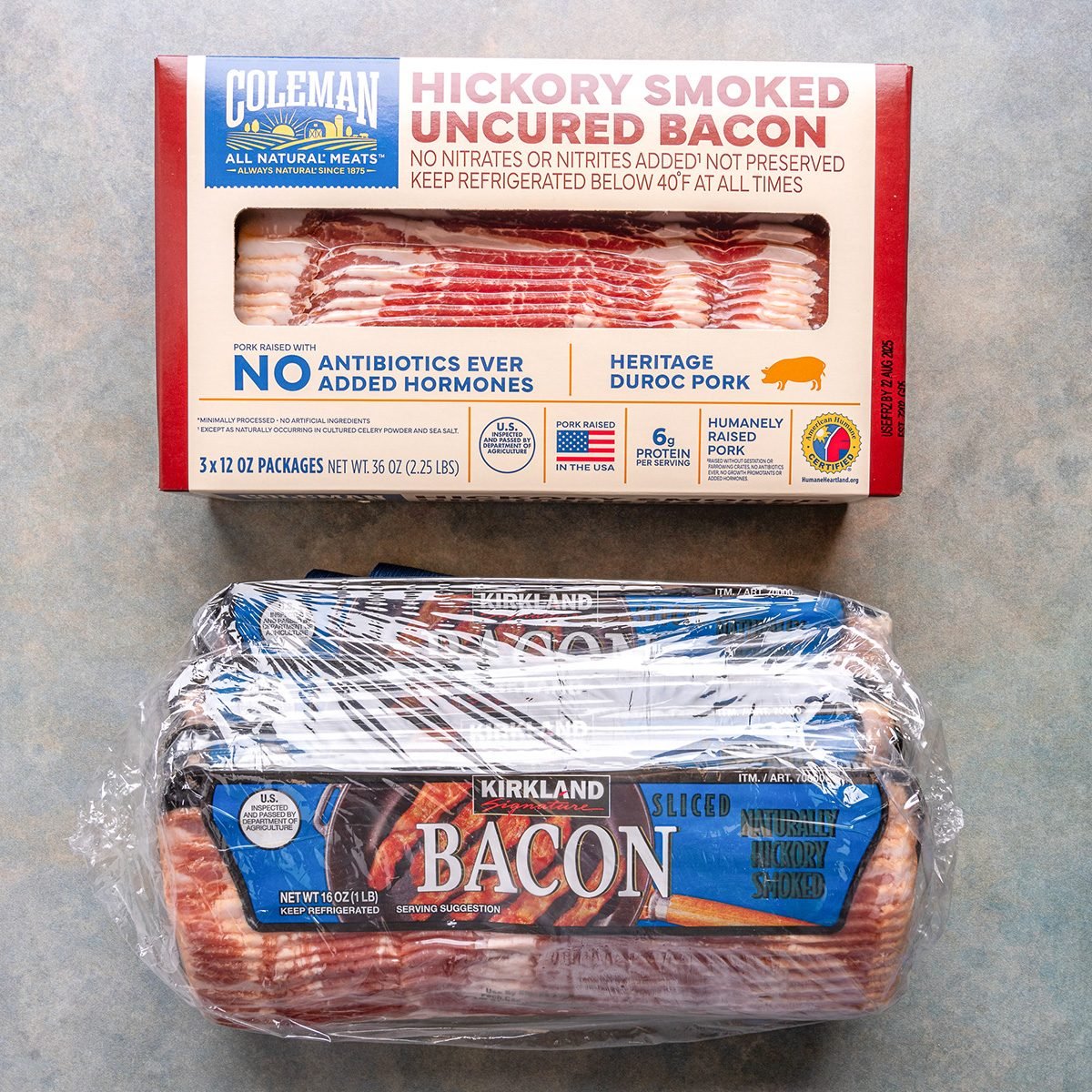
What's better than bacon? A great deal on bacon! We looked into the bulk bacon buying options at Costco to see if the Kirkland brand was just as good as a name brand.
Not a week goes by where I don’t find a package of bacon in my grocery cart or stockpiled in my freezer. Major deals are part of Costco’s allure, so I wanted to take a closer look to see if bacon was worth a name-brand splurge or if the Kirkland brand was a surprising win.
In the end, it came down to Kirkland bacon vs. Coleman bacon. Kirkland products are known to be above average in quality, and so many people swear by them. I am neither a Kirkland devotee, nor a name-brand-only buyer. I usually go with whatever is the best overall value. Therefore, I started this taste test with an open mind and an empty stomach.
Testing Kirkland Bacon vs. Coleman Bacon
Appearance Test

Before cooking the bacon, I took a good look at the uncooked strips of both options. Overall, the thickness of each slice was about the same, but there seemed to be a little more fat on the Kirkland strips (pictured on bottom) and a bit more meat on the Coleman strips (pictured on top).
Then it was time to get cooking. For standardization purposes, I thought it would be best to crisp the strips in an air fryer. I cooked both brands at 400°F for 10 minutes.
Flavor Test

Next came the fun part, the taste test. Before chowing down, I took note of the grease that accumulated on the tray after each was cooked in the air fryer. From the batch of Coleman bacon, I gathered 12 grams of fat. From the Kirkland, 31 grams of grease dripped off. That being said, I also noted that the Coleman brand stuck a little more to the tray.
The Coleman bacon was meatier and with a more robust overall flavor. I noted the Kirkland bacon was decidedly saltier. Upon looking closer at the packaging, this made sense since the Kirkland bacon contained 320 mg of sodium per serving and Coleman bacon came in at 280 mg of sodium per serving.
Texture Test

In terms of texture, both bacon options crisped up well and also made decent crumbles for bacon recipes. The Kirkland bacon skewed a bit more brittle in terms of texture and the Coleman was more meaty and chewy.
Packaging
The Coleman bacon packaging won me over. In fact, I was a bit frustrated when I first picked up the flimsy and slippery plastic wrapping around the four-pack of Kirkland bacon. It was difficult to hold, and the individual packages inside flopped all around. The Coleman bacon was neatly arranged in a box that was easy to pick off the shelf and toss in my cart.
Is Kirkland bacon better than Coleman?
Overall, both Costco bulk bacon options were quite impressive. Neither produced limp nor rubbery strips, they cooked up well and both were delicious on their own or in a sandwich. However, for me, the slightly more expensive Coleman bacon came out on top. This hickory smoked uncured bacon was made without nitrates or nitrites added to the heritage duroc pork. The bacon was more tender, juicy and flavorful than the Kirkland brand. The house-brand option seemed to compensate for lower-quality pork with additional fat and salt.
Coleman bacon came in a box with three 12-ounce packages. That’s 2.25 pounds of bacon for $13.69, or $6.08 per pound. The Kirkland Signature bacon is sold in a pack of four 16-ounce packages for $18.99, or $4.75 per pound. I felt that the difference in flavor, more convenient packaging and humanely raised pork all made the extra expense worth it in the long run.