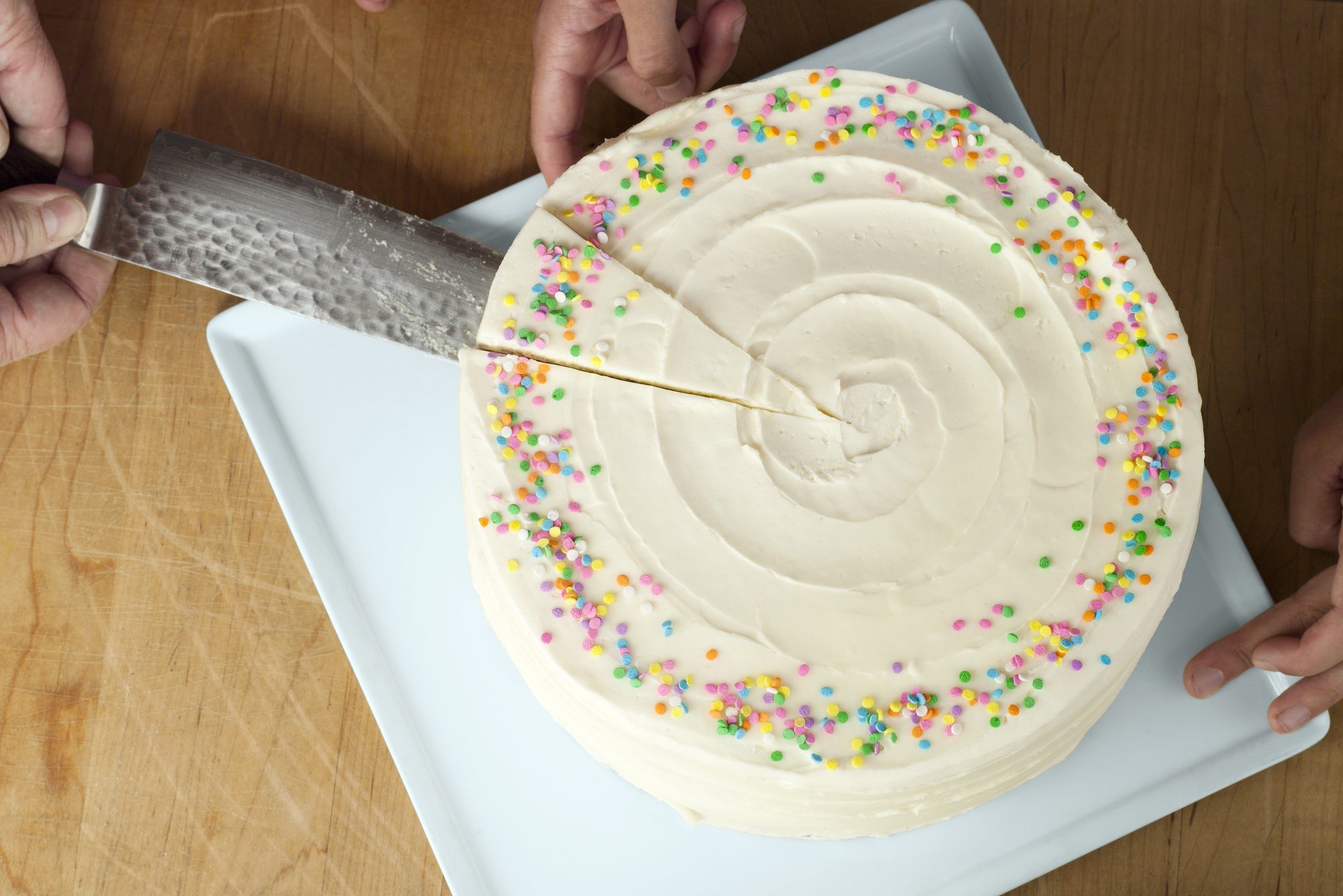
Here's how to cut a round cake properly, with even slices and no messy crumbs.
The day of the party is here! You’ve baked a gorgeous layer cake and applied a smooth, dreamy layer of frosting. Here’s the major trick, though: how to cut a round cake neatly. It’s difficult to slice a cake without smearing frosting or scattering crumbs or serving up a mix of big and skinny slices. Here are our pro tips for how to cut a circle cake perfectly, every single time.
How to Cut a Round Cake the Traditional Way

Traditionally, round cakes are cut into triangular or wedge-shaped slices. While it’s fairly easy to slice this way, it’s also pretty typical to end up with uneven slices—not ideal!
Here’s our tip: Before you cut, take a piece of dental floss and mark a line down the middle of the cake. Rotate 90º and mark the midway line again. Now you’ve got an X marking the center of the cake—each slice should end at this spot.
The lines also lay out a template of four quarters of the cake, which makes it easy to calculate how large to cut slices to serve your guests. For example, if you’re serving 16, divide each quarter of the cake into four slices. In general, slices should be about one or one and a half inches wide.
How to Cut a Round Cake into Rectangles

When you have a lot of people to feed, rectangular slices are the way to go.
Slice one end of the cake, then hold a cutting board against the now flat side of the cake. From there, take your knife and cut an even slice of cake at the same angle the cutting board is being held at. The freshly cut slice will then lean smoothly against the cutting board. Lower the cutting board, cut the new slice into pieces and move the smaller cut piece of sliced cake neatly onto a plate to serve.
If you expect to eat a cake over several days (baking for a small family, for instance), you can try a similar method that also protects the cake from drying out.
Cut the cake in half. Then cut a parallel slice an inch or so away from the first. Carefully lift the long, rectangular slice. Repeat to make as many pieces as you need, always cutting parallel lines across the middle of the cake. (Each long rectangle can be cut to make two or three pieces.) When finished, press the two remaining sides of the cake together. Sandwiched like this, the cake “reseals” and shields itself from drying out.
How to Cut a Round Cake in Concentric Circles

This is a popular method for caterers. It’s great when you’re serving a lot of people and want smaller slices.
Cut a circle two inches from the outside of the cake. Then cut the outside circle into two-inch pieces. Now move in another two inches, cut another circle, slice two-inch pieces and so on until the cake is completely cut. The center core can be cut into triangles or left as is, depending on its size.
How to Remove the First Piece of Cake
Even if your knifework is pristine, it’s tricky to remove the first slice from the cake plate. It’s common to leave the tip of the slice behind—or take the frosting off the neighboring slice!
Here’s how to do it right: Quickly run your knife down both sides of the slice to make sure it’s cut completely through. Then, insert a spatula under the slice, pressing against the plate. Lift straight up. An offset spatula, which has an angled handle, makes it easier to get totally under the cake slice.
Cake Cutting Tips
Use a serrated knife
It seems like a straight blade would be cleaner, but actually, a serrated blade cuts through the cake more easily. A thin blade, like a tomato knife, is best, but a serrated bread knife also works. Use a gentle sawing motion to cut.
Chill the cake for 10 to 15 minutes
Cooling the cake and frosting makes it sturdier and less likely to squish, tear or crumble. A quick stop in the fridge is enough since you don’t want the cake to get too cold before serving—especially if you’ve made buttercream frosting, which can stiffen in the fridge.
Use a hot, clean knife for every slice
Before your first cut, run the knife under hot water, and dry it thoroughly. After every slice, wipe the knife clean, then run it under hot water, and dry it again. It takes extra time, but a warm knife will cut through frosting more cleanly.
If you don’t get it the first time around, don’t sweat it. The good news is, even if your cake is sliced unevenly or the frosting is smudged, it’s still cake—and cake is a good thing.
Practice Making the Perfect Slice