


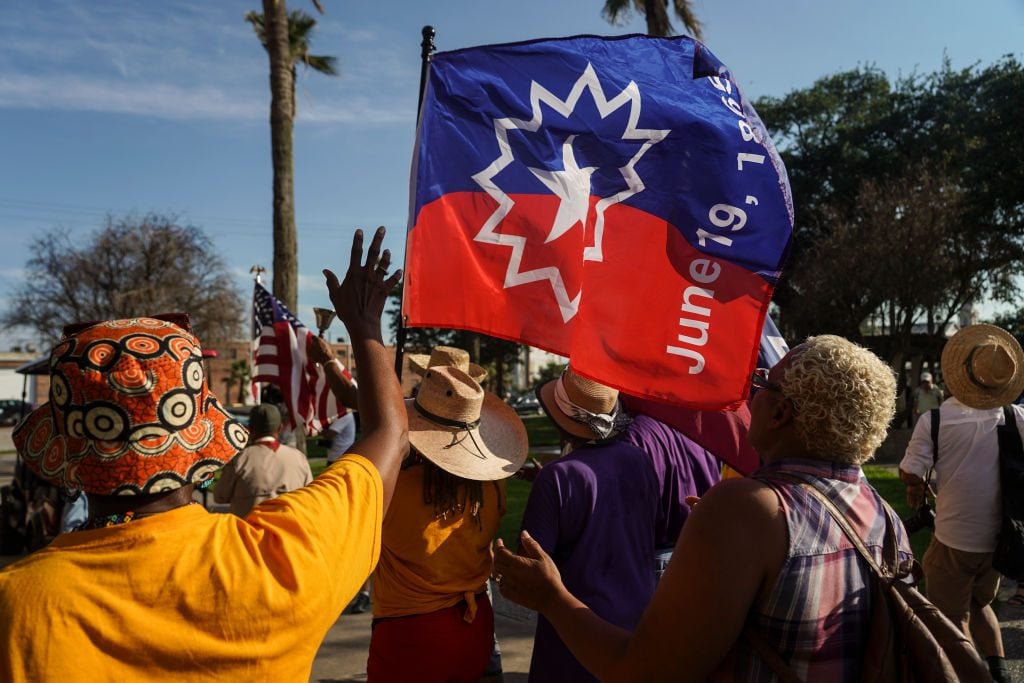
Juneteenth commemorates the emancipation of enslaved people in the United States. Here's a brief history of the holiday and its culinary traditions.
On June 19, 1865, shortly after the end of the Civil War, Union troops arrived to take control of Galveston, Texas. This is when the remaining enslaved Blacks in Texas finally learned of their freedom, nearly three years after Lincoln issued the Emancipation Proclamation. The day became a holiday known as Juneteenth, a portmanteau of “June” and “19th.”
What is Juneteenth?

Sometimes called Juneteenth Independence Day, Freedom Day or Emancipation Day, the holiday celebrated on June 19 commemorates the emancipation of enslaved people in the United States. It was first celebrated in Texas, where, in 1872, Black ministers and businessmen in Houston purchased 10 acres of land and created Emancipation Park for the annual Juneteenth gathering.
Over the years, Juneteenth continued to be celebrated in Texas and gradually spread throughout the South. In June 2021, it was made an official federal holiday.
To commemorate Emancipation Day, friends and family gather to celebrate the legacy of resilience and acknowledge the ongoing struggle of Black Americans through marches, prayers and other remembrances. During gatherings, participants often picnic with one of the nation’s most identifiable culinary traditions: classic soul food dishes.
Traditional Juneteenth Foods

Today, soul food is associated with comfort food, but it was born out of struggle and necessity. Enslaved African people turned meager, low-quality rations into delicious fried, boiled, roasted and baked dishes. In the process, they preserved old food traditions and created new ones. Delving into the history of soul food and Juneteenth is an exploration of Black culture, values and traditions.
The Red Trinity—barbecue, watermelon and red soda—is at the heart of the meal. But no Juneteenth menu is complete without traditional side dishes like collard greens, potato salad and cornbread pudding, or desserts like peach cobbler and banana pudding.
This traditional cooking is an ode to history and heritage, and perhaps no region has had more impact on America’s culinary history than the South.
Why is red food eaten on Juneteeth?

According to culinary historian and food writer Michael Twitty, the popularity of red foods in the community might date back to the enslaved Yoruba and Kongo, who were brought over to Texas in the 19th century. Both cultures consider the color red to be “the embodiment of spiritual power and transformation,” and enslavement narratives from Texas even contain stories of an African ancestor being lured into captivity using red flannel cloth.
Historian Dr. Frederick Opie theorizes that the significance of the color red could be traced back to Asante and Yoruba celebrations, which included “offering up the blood of animals (especially the red blood of white birds and white goats) to their ancestors and gods.”
There’s also another theory—namely, that the color represents the shed blood of enslaved people.
Common red recipes you might find at Juneteenth celebrations include strawberry soda, red velvet cake, grilled baby back ribs, hibiscus iced tea and watermelon salad. There are plenty of cookbooks by black authors to add to your collection, but if you’re looking for one dedicated to Juneteenth, Nicole A. Taylor’s Watermelon & Red Birds is a fun place to start.
Holiday Favorites


