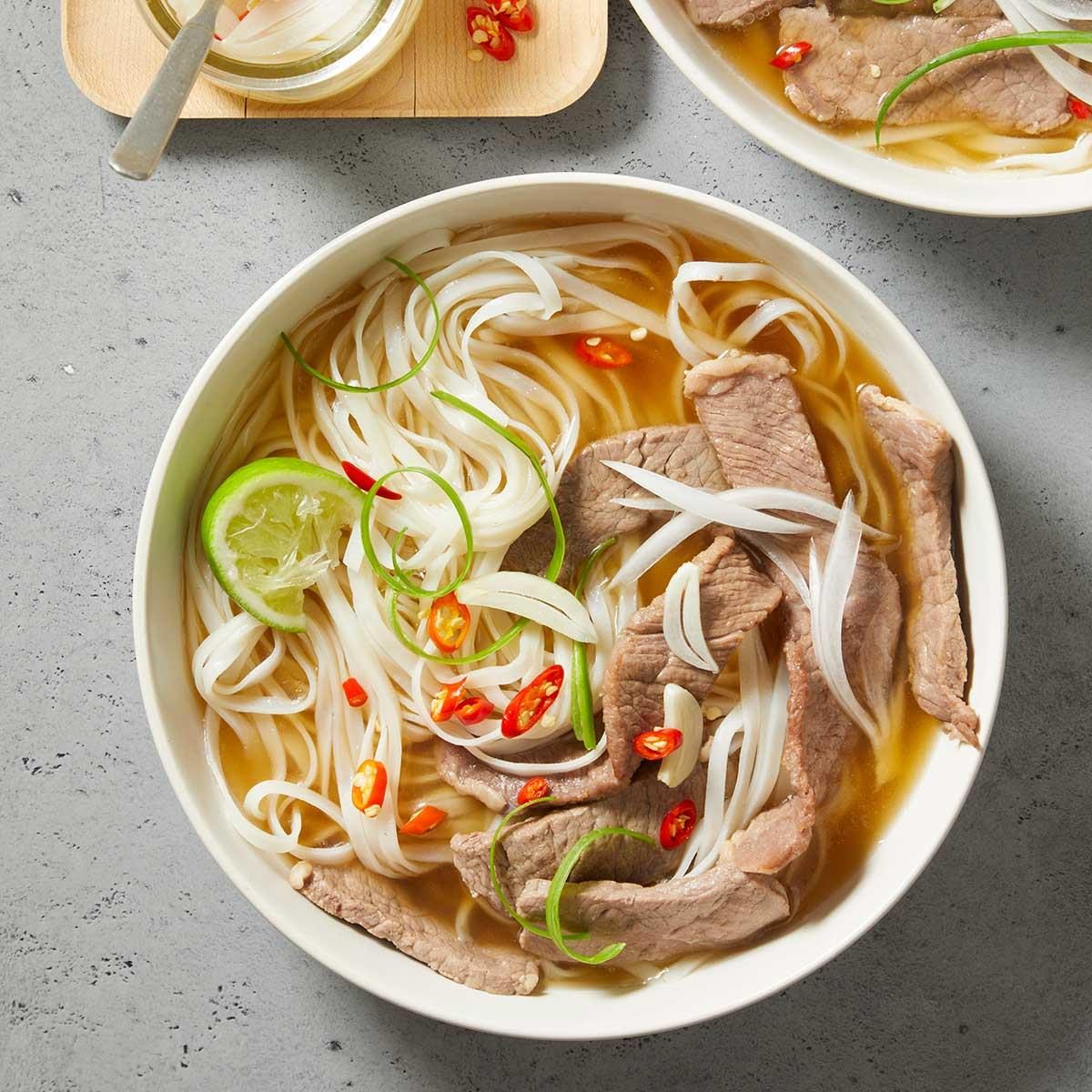
Our pho recipe highlights Vietnam's most notable flavors by combining an aromatic broth, tender slices of meat and refreshing herbs in each sip. Seasoned with cinnamon, star anise and cardamom, our from-scratch broth really makes this pho stand out.
Pho (or phở) is a Vietnamese staple that’s gained popularity worldwide. You’ve probably seen this essential Vietnamese recipe on restaurant menus, and you may wonder if it’s possible to learn how to make pho at home. Although you won’t need to buy any specialty ingredients to make our pho recipe, making the broth from scratch is a time commitment. It needs to simmer for several hours to gain its deep, aromatic character. But it’s 100% worth it when you take that first sip!
A steaming bowl of Vietnamese pho can be enjoyed anytime, no matter the season. In Vietnam, it is commonly eaten for breakfast, lunch or dinner and isn’t necessarily reserved for festive or ceremonial occasions. However, since it takes so long to make, most families have a dedicated recipe that’s passed down between generations. It’s also a popular street food because the rest of the soup is prepared quickly once the broth is ready.
Depending on where you sit down to enjoy a bowl of pho in Vietnam, you might see it served with a wide range of toppings. In northern Hanoi, a bowl of pho will have a translucent broth, thicker rice noodles and minimal toppings. While in southern Ho Chi Minh City, you’ll find a sweeter broth accompanied by an endless flow of fresh herbs and sauces. And in the U.S., you can find both northern and southern-style Vietnamese pho, as well as surprising fusions like pho made with a birria broth.
What is pho?
Pho (pronounced “fuh”) is a Vietnamese noodle soup made with an aromatic beef broth, rice noodles and various cuts of sliced meat. It’s finished with fresh herb garnishes, sauces and a squeeze of lime. Pho’s signature flavor comes from warming spices, including cinnamon, cardamom and star anise, which lend an earthy, aromatic taste. Two of the most popular versions are beef (pho bò) and chicken (pho gà), but pho can be made with pork, seafood or vegetarian ingredients, though they are less common and sometimes controversial.
The origin story of pho—and why it has become so popular in Vietnam—is the result of cultural fusion between French colonizers and local Vietnamese tastes. Local ingredients were used during efforts to re-create pot au feu (French beef stew), creating this unique Vietnamese culinary icon. The beloved soup has a special place in Vietnamese culture, and it can be found at street food stalls and restaurants and in cookbooks. It’s considered the country’s national dish, and its warming, comforting taste has won over the hearts and stomachs of people from all corners of the globe.
How to Make Pho at Home
Making beef pho is relatively straightforward, although the broth takes several hours to prepare. Luckily, pho broth can be made in advance, so you can make it a few days ahead of time. Here are some of our top tips for homemade pho success.
Use both meat and bones: The broth needs meat and bones to become a bold soup base. Use a combination of marrow bones, meaty bones and beefy cuts like brisket.
Soak the meat and bones overnight: Soaking the meat with wine, salt and ginger adds flavor and helps it retain moisture as it simmers. Soaking the bones with cider vinegar helps draw out myoglobin, the protein that gives meat its color. It can make the broth gray and cloudy, which you want to avoid.
Don’t skip the blanching step: Blanching (or parboiling) the meat and bones removes impurities, ensuring the pho broth becomes crystal clear.
Skim the foam: Bones and meat release proteins as they cook, which rise to the top of the broth as foam. The foam is perfectly safe to eat, but removing it keeps the pho broth clear. It will taste cleaner and less gritty.
Toast the spices: Toasting the cinnamon, star anise, cardamom and coriander blooms the spices, waking them up and releasing their aromatic compounds.
Pho Ingredients
JOSH RINK FOR TASTE OF HOME
Banh pho rice noodles: These thick, flat rice noodles have a delicate yet chewy texture that’s perfectly slurpable in noodle soup recipes. If you can find fresh rice noodles at the supermarket, all the better!
Dấm tỏi: This pickled garlic vinegar is a garnish for northern-style pho. The assertive, spicy, tangy condiment is made with garlic, salt, white vinegar, Thai chilis and sugar.
Northern-style garnishes: For northern-style pho, finish each bowl with dấm tỏi, lime wedges, sliced green onions, minced Thai chiles and onion sliced into strips and soaked in ice water to remove its pungent bite.
Southern-style garnishes: For southern-style pho, finish each bowl with fresh mung bean sprouts, hoisin sauce, Sriracha hot sauce, lime wedges, Thai chiles, and fresh herbs like Thai basil, cilantro or mint. If you can find it, use culantro (aka sawtooth herb or ngò ôm), which has a more citrus-forward, peppery flavor than cilantro.
Pho Broth Ingredients
JOSH RINK FOR TASTE OF HOME
Beef: Meaty cuts like beef top sirloin steak and fresh beef brisket are simmered in the broth until tender. Then they’re chilled, sliced and added to the finished bowl of soup. Make sure you buy fresh beef brisket, not corned beef brisket.
Beef bones: The best pho broth is made with a combination of meaty bones and marrow bones, like the femur (leg) or knuckle bones.
Cider vinegar and white wine: These acidic ingredients for Vietnamese pho are used to soak the beef and beef bones, pulling out impurities that can lead to a murky pho broth.
Onion and ginger: Unpeeled, whole ginger and skin-on, whole onions are roasted to add depth and complexity to the pho broth. Peeled and sliced ginger is also used to season the meat.
MSG: Monosodium glutamate (MSG) is a food additive similar to salt but adds umami flavor instead of salinity. The FDA considers MSG to be safe, but feel free to leave it out if you’re not a fan.
Rock sugar: Sugar balances the savory beef flavors and accentuates the warming spices. Rock sugar is slightly less sweet than granulated sugar, which works as a substitution.
Pho broth spices: Cinnamon sticks, star anise, cardamom pods and coriander seeds are fragrant, warming spices that set pho broth apart from regular beef broth. Use whole spices instead of ground spices. Whole spices are fresher, more aromatic and much easier to remove from the broth after it simmers.
Directions
Step 1: Prepare the pickled garlic vinegar
To make the garnish for northern-style pho, brine the sliced garlic by combining it with 1 cup water and 3 teaspoons salt in a small bowl. Cover and refrigerate overnight, then drain it.
In a small jar, combine the brined garlic and vinegar. Heat the remaining 1 cup water until it’s hot, then add it to the jar. Stir in the sugar, the remaining 1 teaspoon salt and the chiles. Cover and let it stand at room temperature overnight.
Step 2: Soak the meat and bones
JOSH RINK FOR TASTE OF HOME
In a large saucepan, cover the beef bones with 2 liters of water. Add 2 tablespoons salt and the cider vinegar.
In another large saucepan, cover the sirloin steak and brisket with the remaining 1 liter of water, the remaining 2 tablespoons salt, the wine and sliced ginger. Cover both saucepans and refrigerate them for two hours. Drain, and discard the ginger from the boneless meat.
Step 3: Blanch the meat and bones
Add enough cold water to each saucepan to cover the bones and meat. Bring the water to a boil over medium-high heat. Boil for three minutes, then drain both saucepans. Rinse the bones and boneless beef under cold water.
Step 4: Simmer the broth
JOSH RINK FOR TASTE OF HOME
Preheat the oven to 425°F. In a stockpot, cover the bones and boneless beef with enough cold water to cover them completely (about 5 liters). Bring the water to a boil over medium-high heat. Reduce the heat and simmer the meat, uncovered, occasionally skimming and discarding any foam that rises to the top.
Simmer until the foam starts to collect more slowly, about 30 minutes.
Editor’s Tip: Using a small mesh strainer is the easiest way to skim the foam from the broth.
Step 5: Roast the onion and ginger, and toast the spices
JOSH RINK FOR TASTE OF HOME
Meanwhile, arrange the whole onion and ginger on an ungreased baking sheet. Roast them until they’re slightly charred, 10 to 15 minutes, turning occasionally. Remove and discard the charred skins. Set the roasted onions and ginger aside.
In a dry small skillet, toast the cinnamon sticks, anise, cardamom pods and coriander over medium heat until they’re aromatic, one to two minutes, stirring frequently. Allow the spices to cool.
Place the cooled spices on a double thickness of cheesecloth. Gather the corners of the cloth to enclose the spices, and tie the bundle securely with string.
Step 6: Add the aromatics to the broth
JOSH RINK FOR TASTE OF HOME
Once the foam is no longer collecting on the surface of the broth, add the roasted onion, ginger and spice bag to the stockpot. Stir in the salt, MSG (if using) and rock sugar. Simmer, uncovered, until the beef is tender, about 1 hour and 30 minutes.
Step 7: Chill the beef
JOSH RINK FOR TASTE OF HOME
With tongs, transfer the beef to a large bowl, and allow it to cool slightly. Wrap the beef tightly in foil and refrigerate it.
Step 8: Continue simmering the broth
Continue simmering the broth, uncovered, until it’s light golden brown and fragrant, two to five hours. Stir occasionally and remove any foam that collects on the surface.
Editor’s Tip: The longer it simmers, the more concentrated the broth. The liquid level will reduce, and it’s OK if the bones aren’t entirely covered by the end of the simmering time. Before serving, season the broth to taste with salt or fish sauce.
Step 9: Warm the noodles and assemble the pho
JOSH RINK FOR TASTE OF HOME
Cook the banh pho rice noodles according to the package directions, and set them aside. Remove the beef from the refrigerator, and thinly slice it against the grain.
JOSH RINK FOR TASTE OF HOME
For each serving, add an individual portion of noodles and beef to a small colander. Lower the colander into the simmering broth until the beef and noodles are heated through. Add the warm beef and noodles to a serving bowl. Top with additional broth, about 1 cup per bowl. Serve with garnishes as desired.
JOSH RINK FOR TASTE OF HOME
How to Serve Pho
Eating pho starts with building the perfect bowl, and there’s no one right way to do it. Two popular ways of serving are the northern-style version from Hanoi (pho bắc) and the southern version from Ho Chi Minh City (pho nạm). Pho bắc uses fewer garnishes and focuses on the delicate broth. It’s garnished simply with dấm tỏi (pickled garlic vinegar) and chiles. Pho nạm is served with dollops of Sriracha or hoisin sauce and a pile of herbs and veggies, like Thai basil, mint leaves, crunchy bean sprouts, thinly sliced onions and culantro.
If you’re still unsure about how to eat pho, try a handful of fresh mint, Thai basil, sliced onions and bean sprouts. Follow up with a drizzle of fresh lime juice for zest, hoisin sauce for sweetness and Sriracha for heat. Typically, pho is eaten with a pair of chopsticks in one hand and a soup spoon in the other. If you’re not the most agile with chopsticks, a fork will do just fine. Swirl your rice noodles into the spoon, dip the noodles into the broth, and top with slices of meat and fresh herbs before savoring your first “perfect” bite. If you’re a fan of contrasting textures, consider making a side of crispy quẩy (fried dough sticks) to dip in your broth to switch it up between bites of noodles.
Pho Variations
Use a shortcut: Instead of learning how to make the pho broth from scratch, use a store-bought beef stock to save time. Simmer the stock with the toasted spices and roasted onion and ginger to add depth. Depending on how long you plan to simmer it, you’ll need 9 to 12 cups of beef broth.
Buy a spice mix: Many Asian grocery stores sell prepackaged spice packs for pho broth. These spice mixes can be really helpful if you’re short on time or can’t find all the needed spices.
Try it with chicken: For chicken pho, make the pho broth with a whole cut-up chicken or an assortment of bone-in chicken pieces. You can also use a store-bought rotisserie chicken or its leftover bones as a timesaving hack.
Make it vegetarian or vegan: Ditch the meat bones and add daikon, carrot, slices of Asian pear, tofu and dried shitake mushrooms to build your vegetarian pho (pho chay) broth. Season it with toasted spices, MSG, mushroom seasoning and some vegetarian fish sauce.
How to Store Pho
Store the dấm tỏi, broth and noodles in separate airtight containers in the refrigerator. Storing the leftover noodles in the broth can cause them to become soggy. Before storing the broth, remove and discard the bones, onion, ginger and spice bundle. Transfer it to an airtight container and refrigerate it for up to three days.
Can you make pho ahead of time?
This pho recipe can easily be made in advance because each bowl is assembled right before eating. The exception is the noodles, which should be prepared right before eating.
Can you freeze pho?
You can freeze pho broth in a freezer-safe container for up to three months. Thaw it in the refrigerator overnight. We don’t recommend freezing the dấm tỏi, noodles or garnishes.
How do you reheat pho?
To reheat pho, bring the broth to a simmer over medium heat in a large saucepan. Reheat the noodles and beef by lowering an individual portion into the simmering broth until heated through.
Pho Tips
JOSH RINK FOR TASTE OF HOME
How do you cook rice noodles for pho recipes?
Rice noodle cooking instructions can vary, as some rice noodles are fresh and others are dried, so we recommend following the package directions. Some packages recommend soaking the noodles in cold or hot water, while others recommend simmering them in boiling water. It’s always best to cook the noodles separately from the soup broth in pho recipes or other noodle soups like Thai chicken noodle soup or coconut curry chicken soup. The noodles are sometimes coated in a starch that can change the broth’s flavor and consistency.
What is the best meat for this pho recipe?
We use beef brisket and top sirloin in this beef pho recipe. These beefy cuts of meat add a rich flavor to the broth and hold up well enough to be sliced and served with the finished soup. Chuck or rump roast also works, but these cuts have a tougher texture. For an even meatier pho, you can add other meats to the bowl. Try thinly sliced steak, shredded chicken, cooked shrimp or the meatballs from Vietnamese chicken meatball soup.
What do you serve with pho?
Pho is filling enough to serve on its own, but you can always add a few sides to round out the meal. In northern Vietnam, people enjoy eating it with a side of quẩy (pronounced “kwai”), which are long golden pieces of deep-fried dough sticks. Similarly, some people order a bánh mì and dip the sandwich into pho broth for the best of both worlds. In Vietnam, many people eat pho with beverages like strong Vietnamese coffee (cà phê), chilled soy milk or fresh fruit juice.
1 piece fresh gingerroot (about 3 ounces), left whole, skin on
2 cinnamon sticks (2.5 inches each)
3 whole star anise
2 large cardamom pods
1 teaspoon coriander seeds
4-1/2 teaspoons salt
1-1/2 teaspoons MSG, optional
1 teaspoon rock sugar or granulated sugar
to serve:
28 ounces Banh Pho rice noodles
Table-side Garnishes (Northern Style): Prepared Dam Toi, 1 large onion halved and sliced into strips soaked in ice water, 4 wedged medium limes, 3 sliced green onions, 8 minced Thai chiles
Table-side Garnishes (Southern Style): Fresh mung bean sprouts, hoisin sauce, sriracha, lime wedges, Thai chiles and chopped fresh Thai basil, coriander, mint and Culantro (sawtooth herb/Ngo om)
For Dam Toi, which is used as a garnish for northern style pho, in a small bowl, combine sliced garlic, 1 cup water and 3 teaspoons salt. Cover and refrigerate overnight; drain. In a small jar, combine sliced garlic and vinegar. Heat remaining 1 cup water until hot; add to jar. Stir in sugar, remaining 1 teaspoon salt and chiles. Cover and let stand at room temperature overnight.
In a large saucepan, cover beef bones with 2 liters water. Add 2 tablespoons salt and cider vinegar. In another large saucepan, cover boneless beef with remaining 1 liter water, remaining 2 tablespoons salt, wine and sliced ginger. Cover both saucepans and refrigerate 2 hours; drain (discarding ginger from boneless meat). Add enough cold water to each saucepan to cover bones and meat. Bring to a boil over medium-high heat. Boil 3 minutes; drain both saucepans and rinse bones and and boneless beef.
Preheat oven to 425°. In a stockpot, cover bones and boneless beef with enough cold water to cover completely (about 5 liters). Bring to a boil over medium-high heat. Reduce heat; simmer, uncovered, skimming and discarding foam occasionally. Simmer until foam starts to collect more slowly, about 30 minutes.
Meanwhile, arrange whole onion and whole ginger on an ungreased baking sheet. Roast until slightly charred, 10-15 minutes, turning occasionally. Remove and discard charred skins; set aside.
In a dry small skillet, toast cinnamon sticks, anise, cardamom pods and coriander over medium heat until aromatic, 1-2 minutes, stirring frequently. Cool. Place spices on a double thickness of cheesecloth. Gather corners of cloth to enclose spices; tie securely with string.
Once foam is no longer collecting on surface of broth, add onion and ginger and spice bag. Stir in salt, MSG if desired and rock sugar. Simmer, uncovered, until beef is tender, about 1-1/2 hours. With tongs, remove beef to a large bowl; cool slightly. Wrap beef tightly in foil and refrigerate.
Continue simmering broth, uncovered, until broth is light golden brown and fragrant, 2-5 hours, stirring occasionally and removing any foam that collects on the surface.
To serve, cook Banh Pho according to package directions; set aside. Remove beef from refrigerator and thinly slice against the grain. For each serving, in a small colander, add an individual portion of noodles and beef. Lower colander into simmering broth until beef and noodles are heated through. Add beef and noodles to a serving bowl. Top with additional broth, about 1 cup. Serve with garnishes as desired.
Loading Popular in the Community
Pho is one of Vietnam's most well-known dishes. For many families, the cooking of the dish is a true labor of love and care. With its aromatic broth, slurpable rice noodles and many delicious garnish options, it is very easy to customize a bowl to suit your tastes. —Taste of Home Test Kitchen
Recipe Creator
Loading Reviews
We are no longer supporting IE (Internet Explorer) as we strive to provide site experiences for browsers that support new web standards and security practices.