


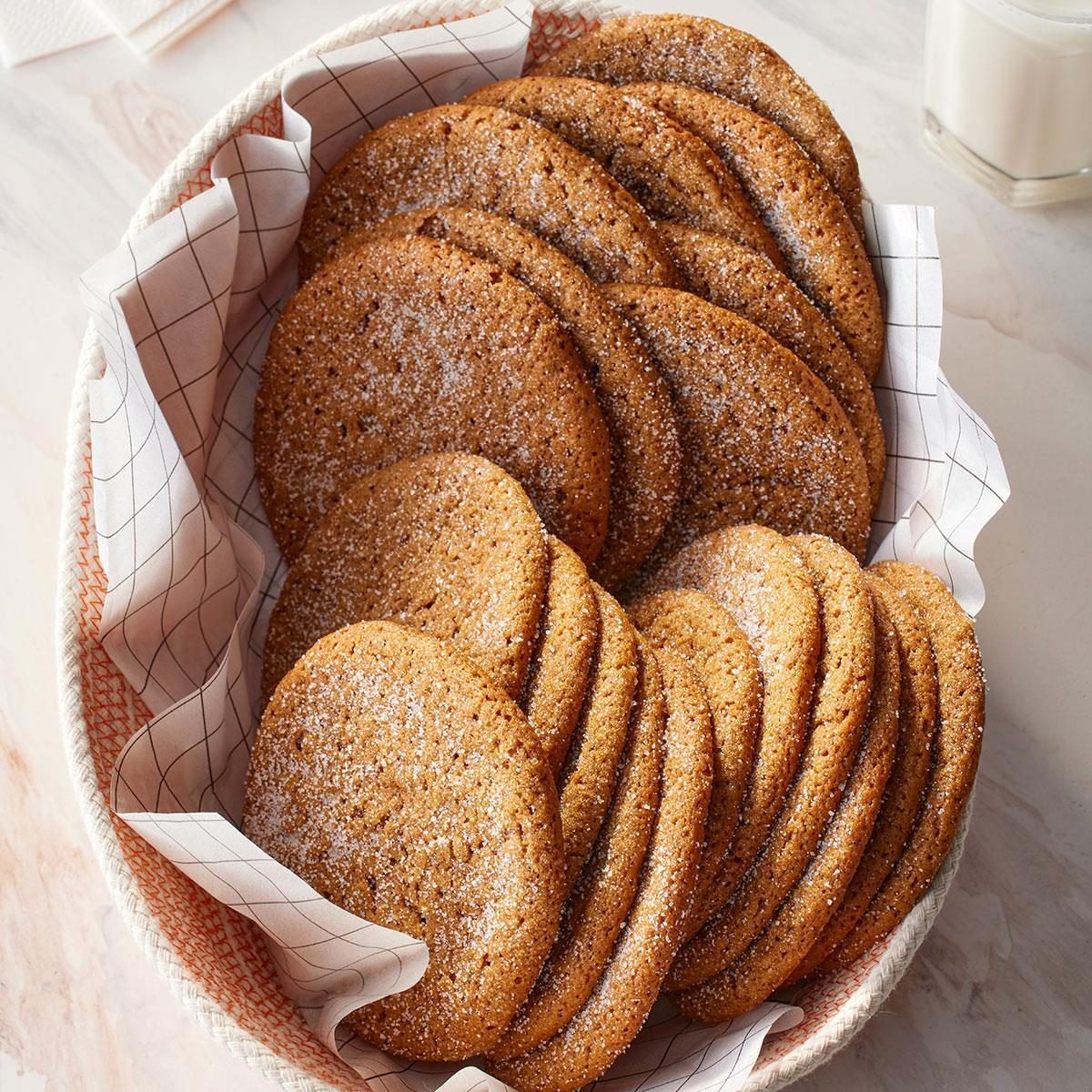
Massachusetts natives love big, soft, sweet Joe Frogger cookies—and we do too. Here's how to make them at home.
If you love molasses desserts like gingerbread cake, shoofly pie and pfeffernuesse cookies, Joe Froggers will be a yummy addition to your collection. These soft, spiced cookies with molasses, rum, ginger and cloves are one of our favorite Massachusetts recipes.
What are Joe Froggers?
Though they share some of the same ingredients as gingerbread, these cookies have a few key differences as well as a rich history.
While classic gingerbread cookie dough contains eggs and butter, Joe Froggers are made with shortening instead of eggs, as well as hot water and a splash of rum. The result is a sticky dough that bakes up into chewy, soft cookies. These large cookies contain no cinnamon; instead, the flavor focus is on ginger, with sweet molasses enhanced by rum.
The coastal town of Marblehead, Massachusetts, lays claim to these sweet cookies. Joseph Brown, an emancipated slave and Revolutionary War soldier, owned a tavern there with his wife, Lucretia Brown, in the early 1800s. Known as “Black Joe’s,” the tavern catered to Marblehead’s tough fishing crowd and visiting seafarers. They served rum and rum-based drinks, as well as Lucretia’s cooking. The Joe Frogger cookie recipe is often attributed to her, and was said to have been named for Joe Brown and served at the tavern. It’s made with staple ingredients of the era: molasses, locally distilled rum and spices like ginger.
The cookie’s name is very similar to another food of the time called a “joe flogger,” which was a type of cake made with dried fruit that sailors took as provisions on long voyages. Given the maritime connection, it’s a reasonable leap that Joe and Lucretia Brown’s cookies could have evolved from these fruitcakes. The name could have also been a nod to the frog pond that was near the tavern, especially considering some old recipes say they’re as big as a lily pad.
Ingredients for Joe Froggers
- Molasses: Molasses recipes are surprisingly versatile, ranging from sweet to savory. But in this cookie recipe, molasses sweetens the Joe Froggers and gives them a chewy texture.
- Brown sugar: This type of sugar also adds sweetness and moisture. Use light brown sugar or dark brown sugar for a slightly stronger flavor.
- Spices: The Joe Frogger cookie recipe has a warm spice blend of ginger, nutmeg, cloves and allspice. A little salt in the dough makes the flavors really pop.
- Shortening: Use a vegetable shortening such as Crisco to give these cookies a tender texture.
- Flour: Use all-purpose flour for these cookies. Make sure to measure flour correctly so that your bakes turn out perfectly every time.
- Rum: Just a little rum accentuates the molasses flavor in the cookies. You can also use rum extract as a substitute for liquor.
- Baking soda: This leavening agent is activated by acidic ingredients like molasses and brown sugar, and gives the cookies a lighter texture.
- Granulated sugar: A light coating of sugar on the outside of the dough balls gives the finished cookies a little sparkle and a crunchy texture.
Directions
Step 1: Make the cookie dough
Cream the shortening and brown sugar together in a large bowl until they’re light and fluffy, about five to seven minutes. In a small bowl, whisk together the molasses, rum and hot water.
In another bowl, whisk together the flour, salt, ginger, baking soda, cloves, nutmeg and allspice. Add the dry ingredients to the creamed mixture alternately with the molasses mixture, beating after each addition. Cover and refrigerate the dough for four hours or until it’s easy to handle.
Editor’s Tip: While four hours is the minimum chill time, you can chill the dough overnight if it’s easier to prep the dough ahead before baking.
Step 2: Prepare the cookies
Preheat the oven to 375°F. Shape the dough into 1-1/2-inch balls and place them 3 inches apart onto greased baking sheets. Flatten the cookies to a 1/2-inch thickness using the bottom of a glass dipped in granulated sugar.
Editor’s Tip: You can either grease the baking sheets or line them with parchment paper.
Step 3: Bake the cookies
Place the cookies in the oven and bake them for 12 to 14 minutes, or until they’re lightly browned. Cool the cookies on the pans for two minutes, then transfer them to a wire rack to cool completely. Store them in an airtight container.

Joe Froggers Variations
- Add a sweet glaze: Dip or drizzle the tops of the cooled Joe Frogger cookies with a simple confectioners’ sugar glaze. You can flavor it with vanilla extract, rum extract or with a little lemon juice.
- Turn them into sandwich cookies: Spread a little homemade buttercream frosting on the bottom of a Joe Frogger and sandwich it with another one.
- Fold in raisins: Add a cup or so of raisins to the cookie for a flavor and moist texture similar to that of old-fashioned hermits.
How to Store Joe Froggers
The recipe for Joe Frogger cookies yields spiced treats that are soft and chewy, but that texture will quickly change to crispy if you don’t keep them in a tightly sealed food storage container. As soon as the cookies are fully cooled, transfer them to the container and cover it tightly. Store the cookies at room temperature.
How long do Joe Froggers last?
When kept in an airtight container, the Joe Frogger cookies will have a soft texture for up to a week.
Can you freeze Joe Froggers?
Yes, you can freeze Joe Froggers. This is a fantastic way to keep a sweet treat on hand for future cravings. Layer the cooled cookies in a freezer-proof container, with sheets of waxed paper between the layers. Seal the container tightly. Store the cookies in the freezer for up to three months. To thaw the cookies, move the container to the fridge.
Can you make Joe Frogger dough ahead of time?
You can make Joe Frogger dough in advance. A longer chill time will actually make it easier to roll the sticky dough. Wrap the cookie dough well and store it in the fridge for up to three days. You can also freeze the cookie dough for up to three months.
To use frozen cookie dough, allow it to thaw in the fridge overnight. Or, move it to the counter to defrost more quickly at room temperature. Just make sure the dough is still cold when it’s time to make the cookies.
Joe Froggers Tips

What if the dough is too sticky to work with?
Because of the molasses and water, Joe Frogger cookie dough is sticky by nature. That’s why it’s important to give it enough time to chill in the fridge before using it. If the dough is still sticky even after chilling, you can lightly grease your fingers or use a spring-loaded cookie scoop (an essential cookie baking tool) to make the dough balls easier to roll.
Can you make cutout Joe Frogger cookies with this dough?
Yes, you can make cutouts with Joe Frogger cookie dough using round or shaped cookie cutters. They’ll just be puffed and soft once baked. To do this, chill the dough, then roll it out between sheets of waxed or parchment paper to a 1/4-inch thickness. Make the cutouts and place them on a lined or greased baking sheet. Begin checking the cookies for doneness after about eight minutes.
Ingredients
- 1/2 cup shortening
- 1 cup packed brown sugar
- 1 cup molasses
- 1/3 cup hot water
- 2 tablespoons rum or 1 teaspoon rum extract
- 3-1/2 cups all-purpose flour
- 1-1/2 teaspoons salt
- 1-1/2 teaspoons ground ginger
- 1 teaspoon baking soda
- 1/2 teaspoon ground cloves
- 1/2 teaspoon ground nutmeg
- 1/4 teaspoon ground allspice
- Sugar
Directions
- In a large bowl, cream shortening and brown sugar until light and fluffy, 5-7 minutes. In a small bowl, whisk molasses, hot water and rum. In another bowl, whisk flour, salt, ginger, baking soda, cloves, nutmeg and allspice; add to creamed mixture alternately with molasses mixture, beating after each addition. Refrigerate, covered, 4 hours or until easy to handle.
- Preheat oven to 375°. Shape dough into 1-1/2-in. balls and place 3 in. apart on greased baking sheets. Flatten to 1/2-in. thickness with bottom of a glass dipped into sugar.
- Bake 12-14 minutes or until lightly browned. Cool on pans 2 minutes. Remove to wire racks to cool completely. Store in airtight containers.

Loading Popular in the Community
Large, soft and chewy, these cookies are made to be munched. The classic recipe has a warm blend of spices that seems stronger the second day. Your family will definitely ask you to make them again! —Taste of Home Test Kitchen, Milwaukee, Wisconsin
Recipe Creator
Loading Reviews

