When it comes to the Big 3 wireless carriers, the numbers they release each quarter mean something. For years, T-Mobile would lead the industry in net postpaid phone additions and other similar metrics almost every quarter. Eventually, T-Mobile surpassed Verizon to become the nation's largest wireless carrier. We will soon get a look at the current state of the industry as we are getting close to the release of Q4 2025 earnings reports from AT&T (January 28th), Verizon (January 30th), and T-Mobile (February 11th).
AT&T's higher Q3 postpaid phone churn tracked J.D. Power statistics
The numbers released by AT&T for the third quarter of 2025 were not good. Postpaid phone churn, or the percentage of its postpaid phone customers dropping their AT&T service or switching carriers, rose 14 basis points year-over-year to .92%. Talking about the rising churn rate, John Stankey, AT&T CEO, said that T-Mobile and Verizon have been "pretty aggressive" with the tactics they employ seeking to get new customers.
Recommended For You
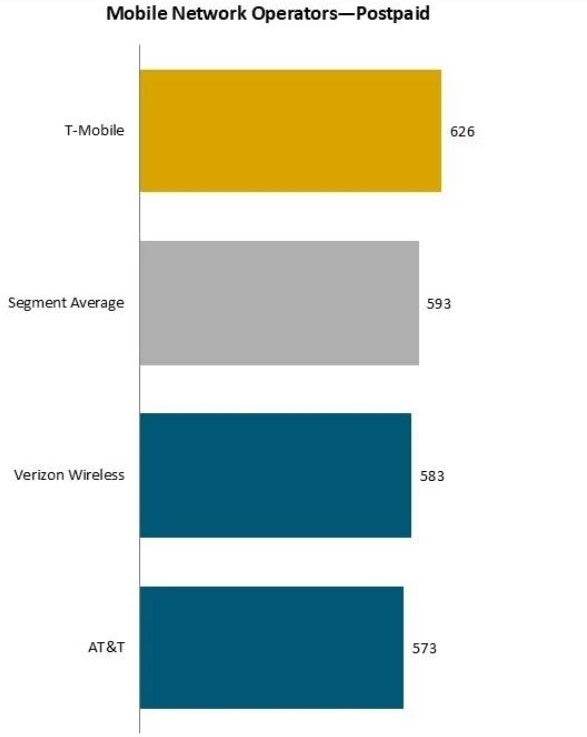
The churn also tracks with a J.D. Power survey released last summer that says when it comes to customer satisfaction, AT&T trails its rivals. On a 1,000-point scale, the average customer satisfaction score for mobile network operators' postpaid plans was 593 out of a maximum 1,000 points. T-Mobile had the highest score of 636 followed by Verizon with 583 and AT&T with 573 points.
The results of J.D. Power's 2025 customer satisfaction test for mobile network operators. | Image credit-J.D. Powe
Recommended For You
J.D. Power's senior director of technology, media and telecom Carl Lepper said when the scores were released, "The findings show that value is the most important driver of the overall experience, followed closely by service quality. These two dimensions are central to our new model—and for good reason. As the market expands with a wide variety of brands designed to meet diverse customer needs, expectations are rising—not just for strong network performance, but also for service plans that reflect individual preferences.”
RootMetrics had a surprise announcement last summer
AT&T's CEO Stankey said, "It’s been competitive. It continues to be competitive. There are shifts in tactics all the time that occur in this market, and we’re in a cycle right now that, because of the maturity level, tactics have shifted."
Not all of the numbers were bad for AT&T. RootMetrics, using scientific testing and professional equipment, named AT&T the top carrier in the U.S. for the first half of 2025. AT&T beat out Verizon and T-Mobile because of its consistency. AT&T delivered stable results across the country which gave it the title even if it didn't have the top score in each city. On the other hand, Ookla and Opensignal named T-Mobile as the top carrier for the first half of 2025 in the U.S.
Ookla said that T-Mobile was the fastest wireless provider in the U.S. during the first six months of 2025 with a score of 58.02. Verizon was second (52.57), and AT&T was a distant third (44.36). Both Ookla and Opensignal used crowdsourced data comprised of speed tests submitted by mobile device users. T-Mobile usually wins based on such real life speed tests thanks to the mid-band 2.5GHz spectrum it acquired from Sprint in the $26.5 billion acquisition. Verizon often finishes first for 5G Experience or Video Performance.
Surprisingly, AT&T's shares outperformed both Verizon and T-Mobile's stock over the last year
AT&T has been the best performing stock among the Big 3 over the last year rising 8.34% to close last Friday at $24.56. Over the last year, T-Mobile declined 8.91% to $199.58, and Verizon rose .65% to $40.52.
Analysts expect AT&T to report $32.29 billion during Q4 2025. That would be a year-over-year increase of .8%. The consensus forecast shows AT&T earning 47 cents a share, a 13% decline from the 54 cents per share it earned during the same quarter in 2024. Postpaid phone net additions are predicted to be in the neighborhood of 465,000. That would be a decline of 11.5% compared to the 526,000 postpaid phone net additions reported for Q4 2024. At a range of .84%-.86%, AT&T's postpaid phone churn is expected to be flat on a year-over-year basis.
Alan, an ardent smartphone enthusiast and a veteran writer at PhoneArena since 2009, has witnessed and chronicled the transformative years of mobile technology. Owning iconic phones from the original iPhone to the iPhone 15 Pro Max, he has seen smartphones evolve into a global phenomenon. Beyond smartphones, Alan has covered the emergence of tablets, smartwatches, and smart speakers.
A discussion is a place, where people can voice their opinion, no matter if it
is positive, neutral or negative. However, when posting, one must stay true to the topic, and not just share some
random thoughts, which are not directly related to the matter.
Things that are NOT allowed:
Off-topic talk - you must stick to the subject of discussion
Offensive, hate speech - if you want to say something, say it politely
Spam/Advertisements - these posts are deleted
Multiple accounts - one person can have only one account
Impersonations and offensive nicknames - these accounts get banned
To help keep our community safe and free from spam, we apply temporary limits to newly created accounts:
New accounts created within the last 24 hours may experience restrictions on how frequently they can
post or comment.
These limits are in place as a precaution and will automatically lift.
Moderation is done by humans. We try to be as objective as possible and moderate with zero bias. If you think a
post should be moderated - please, report it.
Have a question about the rules or why you have been moderated/limited/banned? Please,
contact us.












Things that are NOT allowed:
To help keep our community safe and free from spam, we apply temporary limits to newly created accounts: