Motorola’s Razr Fold beats the Pixel Fold and matches the Z Fold 7, but is that enough?
The real test starts where the spec sheet ends.
This article may contain personal views and opinion from the author.

Promotional image of a person using the Moto Pen Ultra with the Razr Fold. | Image by Motorola
Almost immediately after it entered the foldable market, Motorola made it clear that it knows how to make a good flip phone. In fact, I’d go as far as to say that it makes the best ones.
But now, with the Razr Fold coming this year, the company is entering a much more competitive segment—big foldables. There are plenty of players in the mix, with Samsung and Google being the main competitors Motorola will be facing in the US.
The question is, though, will that be enough to tackle the big dogs?
The hardware looks surprisingly mature for a first-gen device

Motorola did not just enter the foldable race. It showed up ready to compete. | Image by Motorola
First things first, hardware. We are no longer in the early days of foldable phones when they were clunky and cumbersome. The formfactor and the tech behind it have evolved enough to tackle the first issue of large foldables, namely their size.
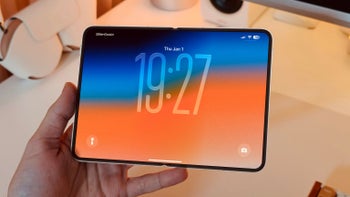
The Razr Fold comes with a massive 6.6-inch cover display with even and acceptably sized bezels that are seemingly slimmer than the Pixel 10 Pro Fold’s and only slightly behind the Galaxy Z Fold 7. On the inside we have an 8.1-inch, which makes it marginally larger than both Samsung’s and Google’s current-generation devices.
More important than the screen sizes, however, is how thin the Razr Fold is, and while Motorola hasn’t given exact dimensions yet, hands-on images give us some basic impression of what to expect.
Another major hurdle with foldable phones is the crease that forms on the main screen. The recent Razr Flip phones have mostly made it invisible, and it appears that’s also the case for the Razr Fold. That said, every brand-new foldable looks crease-free under controlled lighting. The real test comes after months of use.
Cameras are Motorola’s weakness but also its biggest potential for growth

Motorola is promising real flagship cameras on a foldable. Now it has to prove it. | Image by Motorola
Foldables often compromise on cameras. The Pixel 10 Pro Fold, for example, leans heavily on computational photography but still can’t match Google’s regular Pixels. The case is similar with Samsung’s Z Fold line, which is clearly outmatched by the Galaxy S Ultra.
However, Motorola seems to be trying something different.
The phone will come with three 50 MP cameras on the back: wide, ultrawide, and a 3x telephoto. While that sounds like a flagship-class setup, megapixels don’t mean much on their own. The sensors powering those cameras are the most important part, but also the processing and tuning that’s on the software side.
Unfortunately, we know almost nothing about how these cameras perform right now. Motorola did not allow camera testing during the early hands-on sessions, describing the software as unfinished.
The stylus support

Stylus support sets the Razr Fold apart, but Motorola has to make the software unique and useful. | Image by Motorola
The Razr Fold supports the Moto Pen Ultra. Neither Samsung’s current US Galaxy Z Fold models nor Google’s Pixel Fold lineup offer comparable stylus functionality in this category. That gives Motorola something tangible to market apart from the design.
But stylus support is only meaningful if the software supports it well. And that leads us to the biggest question surrounding this device.
The real battle is not with hardware

No amount of design polishing can make a device good if its software is mediocre. | Image by Motorola
Hardware is the easy part to evaluate at a trade show. Not so much the case with software.
Samsung and Google did not build their foldable software experiences overnight. Samsung has iterated on multitasking for eight generations of Galaxy Z Fold devices. Google has leveraged its tablet experience and Open Canvas to adapt Android for large screens.
Motorola, on the other hand, does not have a lot of experience here. That said, the Razr lineup balances widgets, apps, and cover display functionality better than any other flip phone on the market, so I have confidence that Motorola will do a good job when it comes to optimizing the software.
Is Motorola’s timing brave, smart, or reckless?
Why now?
Samsung is entering its eighth Galaxy Z Fold; Google is approaching its fourth generation of the Pixel Fold, and both companies have absorbed early missteps and matured their designs.
Of course, we can’t forget that Apple is highly rumored to release its first foldable iPhone this year too. If that happens, the entire category will be shaken overnight.
But maybe this is a smart move. By entering the book-style foldable market right before Apple, Motorola ensures its device will get its time in the spotlight, before Apple’s draws all the attention.
After Apple enters the game, though, Motorola will have to find a way to stand out even more. So far, the company’s main strength has been identity. The Pantone colors and textured backs add personality in a category that often defaults to black and gray slabs, but for that to be a strength, the rest of the phone must be top-notch.
Even if the Razr Fold does not prove to be outstanding, it is safe to say it will be a worthy competitor in 2026.
There is genuine merit here.
Motorola is not launching a prototype-like device, but what seems to be hardware that’s in with the times. So far, the design seems on point, and the stylus support will help it stand out from the rest of the pack, at least in the US.
If the battery life is solid and Motorola does its job well with the software, it could genuinely undercut Samsung and Google’s more conservative approach. Pricing is another potential lever Motorola might use to reel in early adopters.
So, I believe the Razr Fold has what it takes to make a dent in the market. Whether it actually does will depend on everything we have not yet seen.
Samsung is entering its eighth Galaxy Z Fold; Google is approaching its fourth generation of the Pixel Fold, and both companies have absorbed early missteps and matured their designs.
Of course, we can’t forget that Apple is highly rumored to release its first foldable iPhone this year too. If that happens, the entire category will be shaken overnight.
But maybe this is a smart move. By entering the book-style foldable market right before Apple, Motorola ensures its device will get its time in the spotlight, before Apple’s draws all the attention.
After Apple enters the game, though, Motorola will have to find a way to stand out even more. So far, the company’s main strength has been identity. The Pantone colors and textured backs add personality in a category that often defaults to black and gray slabs, but for that to be a strength, the rest of the phone must be top-notch.
Cautiously optimistic
Even if the Razr Fold does not prove to be outstanding, it is safe to say it will be a worthy competitor in 2026.
There is genuine merit here.
If the battery life is solid and Motorola does its job well with the software, it could genuinely undercut Samsung and Google’s more conservative approach. Pricing is another potential lever Motorola might use to reel in early adopters.
So, I believe the Razr Fold has what it takes to make a dent in the market. Whether it actually does will depend on everything we have not yet seen.

Follow us on Google News

Popular stories


Latest News

Things that are NOT allowed:
To help keep our community safe and free from spam, we apply temporary limits to newly created accounts: